
If You Haven't Tried Group-Based Initiative, You're Missing Out

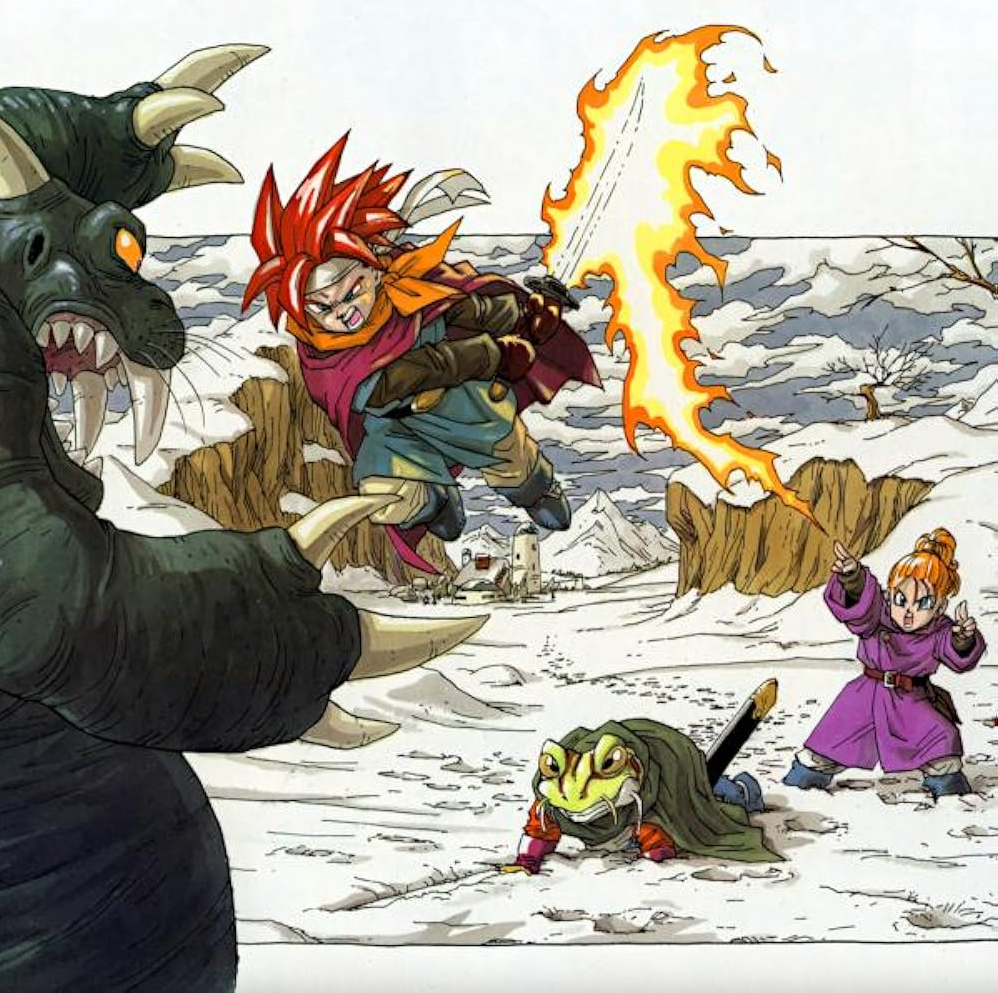
Man, Chrono Trigger is rad as hell. I'm not a JRPG connoisseur, but it's definitely my favorite of the genre by far. Nothing from my childhood will ever be cooler than seeing the characters in that game perform sick ass combos where a guy throws a dude with a sword in the air, someone else charges that sword with magic energy, and then the sword guy lands on the bad guy, stabbing him for a thousand damage. Inject that shit into my veins.
This isn't about to be a "how to add Chrono Trigger Dual/Triple Techs to your RPG game" post, but I can't ignore the fact that group-based initiative is the closest thing I've seen that allow the freeform teamwork that I want to see in RPG combat.
But I'm getting ahead of myself.
The Status Quo
I'd wager most RPG players are intimately familiar with combat run using individual initiative, where combat rounds are split into individual character turns, like so:
Character 1's turn -> Character 2's turn -> Character 3's turn -> ... -> repeat
Turns are discrete, and once they are over, that character has to wait until it becomes their turn again before they can act. Some systems give characters special ways to act when it is not their turn (e.g. reactions), but overall, the individual turn is the fundamental unit of combat procedure segmentation.
This allows for some very cool gamification of combat mechanics, leading to several "combat-as-sport" systems like D&D 5e, Pathfinder 2e, Lancer, and Draw Steel – games where you track individual action types as well as things like "until the end of your next turn" type effects.
There's nothing wrong with this, of course. These games are popular for a reason, and can lead to some awesome moments. I ran a campaign of Lancer and had a combat where a player grappled an enemy twice his size, dragged him clear across the battlefield, and suplexed him into an oncoming missile, and it was all fully by-the-book, no rulings needed. That's some rad shit. You should play Lancer. I wrote an adventure for it and everything.
However, as someone who also enjoys lighter OSR games where gamified combat is not a focus of the play experience, I have often felt like the shackles of individual turn-based combat does not suit the gameplay feel that I seek in those contexts.
In an OSR game, you're a scrappy loser with a rusty sword, a half-burnt torch, a live duck, and a ham sandwich, and you're just trying to get out of this gosh-danged dungeon without those stupid goblins stealing your kidneys. It's not about the combat, it's about the problem-solving, and when the folks at your side are a motley crew of like-minded ne'er-do-wells, you're ravenous for each and every opportunity to leverage those resources in your favor to avoid a grisly fate. In such a game, what I want to see in combat is a team that works together to identify and mitigate threats while advancing their goals.
Teamwork Makes the Dream Work
Group initiative generalizes the combat procedure such that the basic unit of time is the group turn rather than the individual turn – in other words, "all of one side goes at the same time", then "all the other side goes at the same time".
To be clear, I am not referring to discrete character turns being grouped together, e.g. [PC 1 -> PC 2 -> PC 3] -> [NPC 1 -> NPC 2 -> NPC 3]. I am saying that all the PCs go at the same time as one nebulous lump, and then all the opposition goes together as a second nebulous lump, e.g. [all the PCs] -> [all the baddies]. One player's turn doesn't end before another player can take a turn; instead, players declare actions simultaneously, and then those actions are resolved simultaneously (or in whatever order makes the most sense).
I should add that this works best in less rigid combat systems where a player's turn is more or less "move and do a thing". For systems whose combat systems get crunchier than that, you're probably best sticking to individual initiative, but if you're playing an OSR game, something descended from a Borg or a Bastionland[1], or even a game like Mothership, read on.
Here's a detailed breakdown of the procedure, expanded from my post about forecasting enemy intents:
- Each PCs rolls initiative to see who can act on the first round of combat.
- This varies by system, but a general guideline would be something like passing a DC12 DEX/AGI check (Shadowdark/Mork Borg), making a DEX save (Into the Odd, Cairn, Mausritter), or passing a Speed check (Mothership).
- PCs who fail cannot act on the first round of combat.
- Skip initiative in cases of ambush where its obvious which side goes first.
- Describe the current primary threats of the scene. What are the enemies about to do? What bad things are about to happen?
- This sets a stage that clearly delineates what immediate problems the players will need to respond to, on top of whatever goal they have for the scene (the goal is more than just Kill Everybody, right?). It's not just about making Number Go Down, it's about making tough choices about what's most important the group.
- Solicit actions from PCs as a group. Let PCs work together on actions to set each other up for things, dive for cover, take open-ended creative actions, etc.
- Don't roll dice yet. Wait for everyone to declare their actions, then move to the next step.
- Answer clarifying questions as necessary. Players should be clear on what's about to happen, and should have ample opportunity to respond with good plans.
- This includes clarifying how a given set of actions will resolve! If the players need to understand how a set of related actions will resolve, make a ruling and tell them how it would work, but also allow them to change their plans as a result.
- By holding back on dice rolls, you can remain in the liminal space of "nobody has committed to actions yet" as long as your players need so that they can put together a good plan for the turn.
- Not all actions will require rolling dice, of course, and players should know if they are taking such an action.
- Resolve PC actions. This is where dice rolls happen. Resolve actions in the order that makes the most sense according to how you ruled it in step 3.
- For example, if one PC takes an action to distract an enemy before another shoots them, resolve the distraction first, then the attack. One might reasonably rule that if the distraction succeeds, the attack is Enhanced or has Advantage or something along those lines.
- Resolve enemy actions. Deliver on threats that were forecasted in step 2, where applicable. Enemies make attack/damage rolls, etc.
- If the players invalidated an enemy action, or otherwise successfully mitigated a threat, the enemy's action might just be to introduce a new threat for next turn (but otherwise their action this turn was skipped, or less effective).
- If the combat is still going (morale permitting), return to step 2. Otherwise, combat is over.
By presenting threats and then rounding up declared actions as a group, waiting to resolve them until everyone has declared an action, the players are afforded a great deal of information and flexibility with how they deal with those threats, which results in a (surprisingly cinematic) teamwork-oriented combat scene that emphasizes player creativity and problem-solving. Neat, huh?
Corner Cases
There are admittedly a few oddities with how simultaneous initiative actually gets resolved, particularly around how to rule a few different categories of simultaneous action. Here are a few such cases, and how I might rule them, where golden rule is to make a ruling and tell your players the ruling before they commit to the course of action.
Multiple attacks on one target
What if two people attack a target, but the first attack kills the target? Can the second player change their action?
Personally, I'd resolve damage simultaneously here. Into the Odd has the right of it: roll damage together, then resolve the attack with the result of that damage roll. In a system with roll-to-hit, have both players roll their attacks, and collect damage from hits without declaring the target dead until everyone has rolled damage.
The players should know that "overkill" is a risk here. The advantage, though, is that they have two bites at the apple, so to speak: they are guaranteeing that they have two attempts to attack the target, where the risk is that one of those attempts may go to "waste".
In other words: tough beans, but the players chose that risk going into the turn.
"Dependent" actions
What if a PC wants to take an action, but only if another PC succeeds on their action first?
I'll split this into two scenarios: "enhancing" actions and "enabling" actions.
An "enhancing" action is one where, if PC 1 succeeds, PC 2 has some sort of advantage going into their action. It's an action that is doable (not impossible) without PC 1 succeeding, but PC 1 succeeding would make PC 2's action better or easier. For example, PC 1 might want to distract an ogre while PC 2 backstabs it; even if PC 1 fails, PC 2 is still able to attack the ogre, just not as effectively.
For an enhancing action, I would probably still hold the players to their actions. PC 2 ought to know that PC 1 failing their roll is a risk.
An "enabling" action is one where, if PC 1 does not succeed, PC 2's action will definitely fail (or would otherwise be impossible). For example, when facing an enemy protected by an impenetrable magic forcefield, PC 1 might want to take an action to disable the forcefield to let PC 2 attack them with their last Wand of Lightning Bolt charge.
This one is a bit tricky, and is probably up to GM taste in the moment, but in general, I think I would give the PC two options:
- You can choose to attempt the action this turn, but if PC 1 fails, you may forego your action entirely, such that their failure means your turn is forfeit.
- You can choose to do a different action this turn while PC 1 attempts their setup action. If their action succeeds, you can try to take your action to exploit the setup on the following turn.
I think this presents a reasonable choice to the players: do you risk attempting to do the action faster, with the possibility of wasting an action, or do it slowly but with more certainty?
What I would avoid, though, is getting into contingency territory, i.e. "If PC 1 succeeds, I do X, but if they fail, I do Y". Nah, I'm not about to get into that fiddliness. Get a solid commitment: take the risk now, or wait until next turn.
Note that the above choice also applies to the "enhancing" action situation above, except that the player can still choose to take the action (less effectively) if PC 1 fails.
Again, the key is to tell the players the ruling ahead of time so they can plan around it. You're not pulling any fast ones here.
PC actions that invalidate enemy actions
What if a group of goblins are about to shoot arrows at a PC, but the PC's action is to run into a corridor and slam the door closed behind them? Do the goblins choose a different target?
No! That would invalidate the player's choice. Part of the objective is to reward players for addressing and mitigating threats, so if the player mitigates the threat of goblin arrows, then narrate how the arrows thunkthunkthunk into the door behind the PC, who is now safely out of harm's way. Your job is to deliver on the forecasted threats, for better or for worse.
In general, if a PC takes an action that invalidates an enemy action, the reward is that the bad thing that was forecasted doesn't happen, or is otherwise rendered irrelevant, and the enemy "wastes" their turn (narrate the enemy attempting their action and failing due to the players' actions. Haha, sucker!). That enemy may still be around to present a new threat for next turn, but the threat they made this turn was cancelled.
The exception, of course, is the situation where the player explicitly wanted to change the enemy's action. If an enemy is targeting a PC, and another PC jumps in to try to draw attention to them instead (and succeeds), then obviously the enemy is going to attack the second PC instead of their original plan.
I think my favorite thing about this dynamic is that a PC simply attacking the enemy usually doesn't invalidate the threat unless the attack kills the enemy. If the threat is "the ooze is about to glorp you" and your action is "I stab it", then sure, you may do damage, but if the ooze is still alive after that, you get glorped. Thus, in many cases, taking an action other than a simple attack is often a good move if that action stops the enemy from manifesting their threat, which makes combat a lot more interesting and varied.
The Prestige 🎩🪄
And my favorite part about group-based initiative?
It exactly mirrors how non-combat play works too!
When the players enter a new dungeon room, what do you do? You describe the most standout parts of the room that the players might want to interact with, then players declare their actions in the room, you resolve those actions and describe the new state of the world, and you repeat. It's the same thing!
Maintaining the same cadence of play makes it effortless to slip into and out of combat, and makes it so much easier for players to maintain their focus on the fiction of the scenario instead of switching into an entirely new mode of play where they engage with the world on completely different terms.
It takes some getting-used-to, but I have a hard time imagining going back to regular individual initiative in most rules-light RPGs. I could even see some of these principles applied to games descended from Apocalypse World or Blades in the Dark, but I'll stop shy of that conversation before I find myself deeply outside my wheelhouse.
Bonus Variant: Grouped Individual Turns
If your group struggles with the loosey-gooseyness of this system and feel more comfortable with individual turns, I think you can maintain some of the advantages of this approach by letting players take their turns in whatever order they like as a group, as long as they resolve one turn before moving on to the next. This nudges a bit too far into the gamification side for my liking, removing player mindset from engagement with the world to engagement with the rules, but it could be a reasonable middle ground depending on table play culture.
It also expands the scope of which games this playstyle could work with. For example, I don't think I'd use pure group initiative with Nimble, but grouped individual turns would work great with that system (and is pretty close to RAW).
I could even see an additional variant of this approach working in Daggerheart, again pretty close to RAW: players take turns in any order they like (as long as everyone takes a turn before a player repeats – use spotlight tokens to track this), but the GM can spend fear to jump the order with enemy turns (and spend more fear to let more monsters go in sequence).
Wrapping Up
I dunno. I just really like the idea of letting players work together in whatever order they like to solve problems together as a team. Stricter individual initiative has its place and can present a cool challenge to overcome, but IMO that's for a specific style of game that I don't think is the best fit for world-focused[2] games with lighter combat rules.
I'm very curious to hear other thoughts on how effective people find this style of combat in practice. Despite writing two whole blog posts about it, I still think of myself as a neophyte to this approach, and am eager to talk shop about it. Play reports welcome!
- [1] I'm sort of cheating here because group-based initiative is pretty much RAW in many games descended from Into the Odd. For example, in many such games, if multiple people attack a single target, they don't each deal their damage; instead, all damage dice are rolled together and the highest is chosen among them. In order to even be able to decide whose damage dice are allocated where, players have to declare their actions simultaneously, and they can't be resolved until after the actions have been declared. (Notably, Mausritter, despite descending from Into the Odd, appears to omit this combined-roll rule, to its detriment IMO.)
- [2] See question 3 of Sam Sorenson's Three-Question Taxonomy